Rules. Can’t Live with Them. Can’t Live without Them.

Rules. Can’t Live with Them. Can’t Live without Them.

Right off the bat, do you like the idea of having rules or hate it? Chances are if you hate it, it’s because you didn’t make them. How about rules for art? How does that make you feel? Many people bristle at having rules for their art. They think of art as a place to break rules. But whose rules? I want to make a case for creating your own.

The rules to follow in your art practice are the ones you create to make the process easier and get a good result.

That’s not really accurate but it’s more powerful then saying rules are set in place to make the process less frustrating and guide the result in the direction you are hoping for. The process will always be frustrating, and the result is never guaranteed. But to keep from being paralyzed with indecision about how to begin and anxiety riddled with dread that it will all be futile in the end, a few rules are super handy.

Are you with me? Do you want to make some rules? Great! But hold on. Rules can only be formed from analyzing artwork you’ve made that you like. Not artwork that someone else has made. Artwork you made. We will get to that. First you need some constraints. Constraints might become rules but only if you say so.

You don’t get a rule until you find a constraint you really like. What’s so great about constraints? Let me answer a question with a question. Do you prefer making multiple decisions an hour or just one or none? Say it’s around 5 pm and you’re getting hungry, what do you like most, for your spouse/partner/friend/roommate to say I’m getting us some pizza, sound good? Or inform you they just sent an email with 25 new restaurant options, could you take an hour to peruse them all and decide which one to order from. Maybe if it’s 2 pm on a lazy Saturday the second option could be fun, but not for every meal. It’s too tiring and it steals time from the good part, eating and hanging out.

Same with art. Having all the choices just keeps you from getting too it. Whittling down the choices to the ones you will most enjoy is super helpful. A constraint is a way to make entry into the process as easy as it can possibly be. Let’s assume what we want is to be making some art, how can we go from not making art to making art? Make all the decisions that cause waffling ahead of time so that no decisions need to be made during the fragile transition period from everything else you do to making art.

Let me give you an example of something I have been doing for 4 or 5 years that has almost no decisions attached to the entry point. And because of that I’ve made quite a lot.

I make abstracts. Here are the constraints.

  • 9 inch x 9 inch paper
  • Alcohol based markers
  • Abstraction only, no representational imagery

That’s it! Very very easy to start one up. I just get the paper out, get the markers out and go! The first decision I make is the first mark and I usually make it very fast. It really doesn’t matter too much. That’s not true. It probably matters a lot. But thinking about it and getting worried I will mess it up doesn’t alter the way it matters. It doesn’t contribute to something better. The process works just as well if I deliberate or don’t deliberate. That’s the value of constraints!

So how do constraints become rules? Constraints are physical, material and easy to define. Rules are stylistic, aesthetic and related to what pleases you. They would be harder to convey to another person but intuitive to you. Because you decide. You decide based on what you want. How do you know what you want? From looking deeply at what you have already created and noticing what you want more of and want you want less of. If you look at your work and see that some is neat and some is messy, which part excites you, attracts you? Do more of that and less of the other. The rule would be let it be messy or make it neat. Often it’s the relationship between the two, make it two thirds messy, one third neat. Rules aren’t easy to convey to anyone but yourself because you need a very intimate understanding of what you are doing to make them, and you are most likely the only person with that understanding.

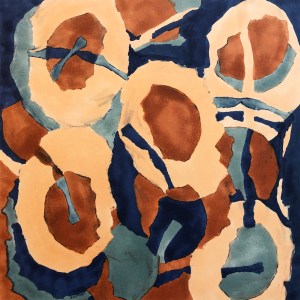
The rule for the two abstracts above was create a pleasing balance between symmetry and chaos. Of all the times I have tried to achieve that, the one on the left is my favorite. The one on the right is not bad but not quite as good to me. I am not going to show you the ones I hate because once I determine I don’t like one, I never want to see it again. I make quite a few of those. Naturally if you are pushing your boundaries, you are bound to fall over them. Failure is also useful for rule formation. The rule is usually a variation on don’t do that again. The trick is to identify what that is. You can’t make it a rule if you don’t analysis it and make it conscious.

Sometimes the rules are use only four colors. Or they revolve around combining a limited set of shapes. Often, it’s a combination of two or more types of rules: Use these colors, use these shapes, make it loose but tidy. The point of the rules is to narrow my focus, so I don’t get overwhelmed. The point is to help me make the one thousand decisions every piece of art demands. The point is to see what happens and lean into the direction that feels good. The point is to make a lot of art. The point is to make some good art. This is how I get there.
Art Making is a Risk

Art Making is a Risk

When you make something, you risk living with the knowledge of your own assessment. Is it good? Is it worthwhile? Does anybody freaking relate to it or care?! The answer is sure to be no as often as yes. The thing you make might be mediocre, useless and ignored by all who know you. Who wants to grapple with that? If avoiding feelings is your number one priority, don’t make anything.

Uh, oh! There’s a problem. Not making art is also risky. You might have to confront the feelings you have about creating nothing and always turning outward for access to interesting stuff.

Art making puts you in direct conversation with your hopes and expectations. That’s some risky business right there because you might not be satisfied with the outcome. But who cares when the process is so fun! Of all the perilous things you could do, making art is the least outwardly consequential. There are no art police, there are no art laws. It’s great territory for private indulgence in extravagant, showy, badass behavior. It’s where you attempt to impress your self over and over. When you succeed, Woah! It feels good! It becomes the thing that makes sense of everything senseless, creating an antidote to the horrors of reality. It’s the vast void from which you conjure the tangible like a medieval wizard. It’s sure to happen if given enough time, space and respect. Personally, I find regular indulgence in the creative process the most satisfying way to know myself and generate love for the world.

All the expectations you encounter, all the self-assessments you give and receive, they can be useful. Mediocre art is always the first step to good art. Useless art is only a breath away from becoming treasure. You can and will find someone who relates to your offering, but only if you have one to give.

Be a delinquent in your art practice. Thumb your nose at whatever you disdain in your art practice. Be wild and daring and reckless in your art practice. Be risky where the reward is greatest and the consequence the least onerous. Otherwise pay your bills on time and call your mother. Everything in its time and place.

Observation x Repetition = Intuition

Observation x Repetition = Intuition

In my late 20’s I worked as a product photographer, shooting doodads for catalogs with medium format cameras. It was heaven. Across the hall from our photography studio was an art studio. It had a cryptic phrase on the door, What we do is secret. I liked that. It appealed to me. I did a lot of secret stuff. Maybe this was my club. Over time I got to know the artist and started taking a painting class there. Scratch the sentence above, this was the real heaven.

There are two things I remember from the class and they’re related. You must look at your work. Closely and often. The teacher had us tape the work to the walls, step back and really stare at it. Over and over. Many times throughout the process of making it. The second was to evaluate the composition. Was it balanced? Did it feel good. You would only know that by doing the first thing, looking at it.

It takes patience, focus and concentration to really look at something. Imagine you had to write an essay on the thing you were looking at. Could you? Can you retain the color palette when you look away, can you describe what is happening in the upper left corner? It’s hard enough to focus on something good, what about looking at something in development, something that is clearly not good. It takes patience, perseverance and something special to identify what is not working and figure out how to fix it. That special thing is what art is all about and it takes a lot of practice.

I quit my photography job and rented a space in the art studio. It was a pleasing and scary surprise to go from employed and stressed to the max, to unemployed and making art every day. From a warm industrial loft to a cold industrial loft, from charming clients with chitchat to listening to Bjork’s Vespertine on repeat. As a very frugal person, this turn of events felt like a fairy tale. My husband (whom I have to thank for financing this interlude) and I joined the San Francisco Modern Art Museum. I went there often and stared at art. Sometimes I would look at a single painting for 15 minutes. I was making the composition conscious in my mind, I was guessing how the artist made the work, what mark came first, what came last. I got really good at looking deeply at art. It was a wonderful time. I think about it as the best time.

I honed my sense of observation like a runner increases endurance. I was regularly doing marathon observations. One thing that happens while observing is ideas bubble up. Let’s say the act of observing is turning the stove on high and ideas are the air pockets surfacing in the boiling water. As you become conscious of what you are looking at, you become conscious of possibilities, of things you can try in your own art.

The next step is to act on one of these ideas, any idea. See what happens and repeat. Repeat the ones that are most interesting and the ones you naturally feel like repeating. No point trying to make yourself do something you aren’t interested in because nothing will come of it. But where there is interest there is the will to experiment. If you keep looking, you will keep having ideas and if you keep acting on those ideas and looking at the outcome you will generate more ideas and more action. This is repetition. It’s a big fruitful circle. Intuition is the final fruit. The noticing, the idea and the desire to take action merge. It’s the whole process in a single flash of insight.


As I mentioned in my post of December 12th, What Value Matters Most, Shoutout LA interviewed me about observation. You can read my response here and see a portrait of me with the doggies! That interview sparked me to sort out my thoughts on the topic of intuition, observation and repetition and this essay today was my attempt to speak about it with more nuance. I cut multiple paragraphs about intuition while editing this to keep it focused on the equation set in the title. But as I still have more to say about these ideas, I’m going to use that material in another post and try and define what exactly intuition is. Are you on the edge of your seat?!