Observation

Observation

I spotted something that surprised me and makes me wonder how observation works. Previous to this I would have defined it as intentional, something I was trying to do, an active activity. Now I think there is a subconscious component.

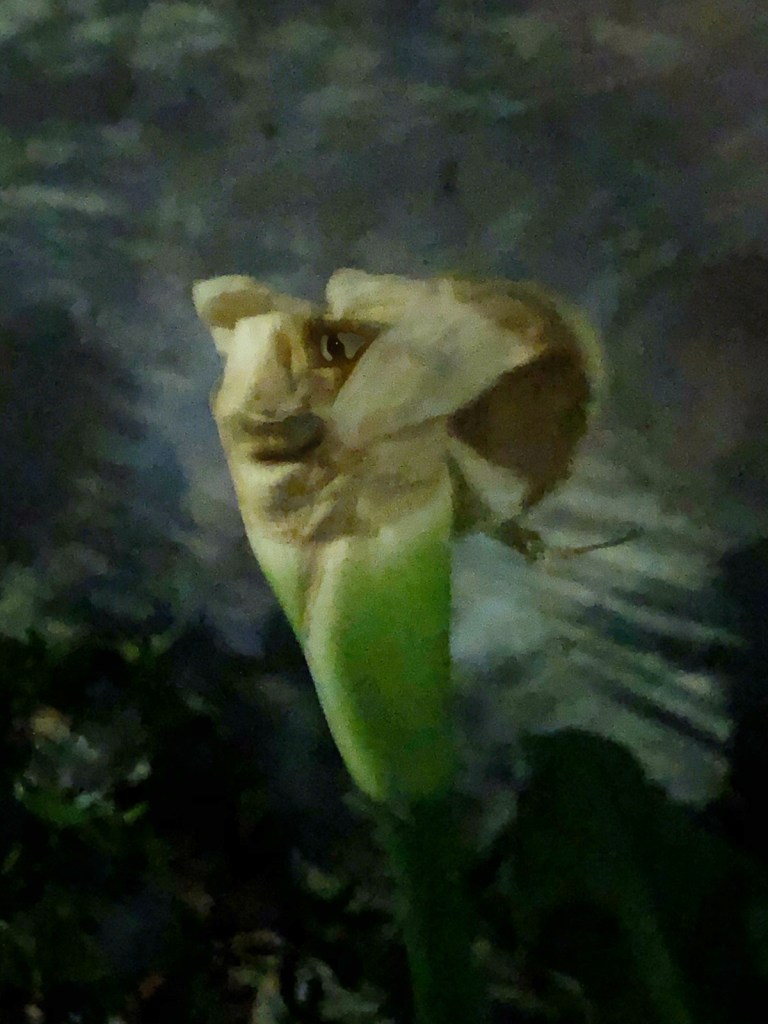
I was walking the dogs at night and we passed by a house with some calla lilies in front of it. I wasn’t looking at the flowers or the house directly. I wasn’t actively looking at or for anything. I was just doing the dogs. Something compels me to turn around and check out this one flower, I sense there might be a face there. I resist a little because it’s dark so who cares. But I do it. Yup! That’s a face. I see a face. I get out my iPhone and shoot the photo below. Nothing. Let me try again. I hold very still and shoot a few more and move on.
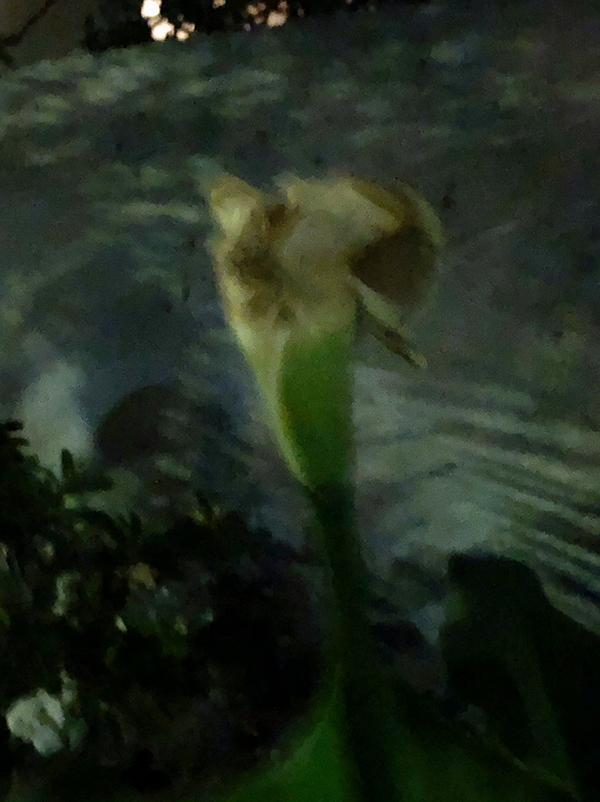
The low light makes them crappy photographs but wow, there is someone there. How did I see this? As best I can recall, I would say my unconsciousness saw him out of the corner of my eye. I guess making faces for five and half years has built up a robust face finding perception. It can’t be turned off. Even when I think it’s off it’s not.

I suspect this works with anything we practice daily. We get so attuned to what we pay attention to that it becomes unconscious. Some people can read other people’s moods just from the way they walk in a room. Someone else sees a luscious red pepper and instantly visualizes a whole meal. I was sitting next to my dad in church as a teenager and he suddenly exclaimed and wrote something down. Very unusual for this stoic and contained man. Later he told me he’d finally solved a math problem that had been bothering him since college. Where did the answer come from? What part of him was working on it? He was a problem solver. I hadn’t thought about it until now, but an unsolved problem must have really bugged him. His brain was attracted to creating solutions. We engage with what is interesting to us. We don’t even have to try; we just do it. That’s how you know what really interests you. It is that which pulls your attention subconsciously.

It’s easier to develop observation as a skill if there is an affinity for what is being observed. My brother observes license plates. I know this because he’s always filling me in on the latest developments. He’s all excited and he’ll say, Caren, I saw a brand-new Toyota with an 8H today! And I’m like, no way dude! Tell me more! Before he started chewing my ear about it, I had never, ever noticed or thought about the sequence of numbers and letters on a license plate and they are everywhere. How many do I see a day? Hundreds? He has brought it up in conversation at least a dozen times. Because he is so passionate, his enthusiasm rubs off on me for a few days. I will notice numbers like crazy and have fun with it. But soon it all slips away because that is not what I am actually interested in.

I am less observant when I am stressed. I block out what I can’t control and don’t want to deal with like laundry that needs to be folded and empty boxes lining the hallway. If my observations are only going to add to my to do list than No Thank You. But there are things I wish I observed that I miss. Birthdays. Following up with people I care about regarding information they’ve shared. Remembering to eat the leftover mashed potatoes before they turn gross. I am pulled in so many directions, I miss things I don’t want to miss. But apparently, even in the dark, I don’t miss a face.

What’s Your Affinity? I Like Faces.

What’s Your Affinity? I Like Faces.

In a recent post I described artistic affinity and used my attraction to gray as an illustration. This may explain why I don’t grow tired of making faces on pavement year after year, but it doesn’t explain my affinity for found object portraiture. Let me use this space as a workbench to try and figure out how to state the deeper affinities that drive all of my art.

My Affinity

Facial expressions are the language of emotion. As pack animals, we are incredibly good at knowing how someone feels internally by reading their external body language. Notice the common verb reading to describe the process of seeing someone and decoding their emotional state. I love looking at my faces after I have made them and “reading” the emotion they are projecting. I usually have some idea about it in the moment of making it but I work so fast and under such ephemeral conditions, that I don’t spend much time on that part during the making of them. I have a strong intuitive sense I got it, or I might keep going. I know when a face is blah, or worse, inauthenticc. But it’s happening almost unconsciously on my part. I don’t intentionally bring my consciousness to it until I look at later on my computer screen. In this sense, my process accommodates to two versions of my inner artist, the hunter/gatherer and the cook. Each suits my affinities.

The Hunter/Gatherer

I love to walk around and notice things. I love having a task while I do it. The task is called find supplies and find something unique we can use to make a face. I just really really enjoy this. It’s natural and easy. This hunter/gatherer is less interested in what is going to happen to the face that she makes and more interested in just hunting it and gathering it. The thrill is being finely attuned to one’s surroundings.

The Cook

The cook is interested in what has been brought to her. She is selective and is looking for a harmonious combination of good composition, lighting and facial expression. She wants a very definitive emotion to be coming across. The face should suggest a story, a story which explains the emotion. Many faces don’t meet these requirements and don’t get shared. The cook wants to share her creation. The cook is thinking about who will eat her food. She wants to please and delight them. The hunter/gatherer only wants to please the cook.

The Attraction

The attraction is not really towards the object, but rather the adventure and the reward. I feel rewarded by creating an expression. I like people. I like stories. Facial expressions are very short stories told in the medium of the flesh when real and the medium of pavement when I do it. I don’t get bored, or tired, or done with making faces. Each new one delights me. That’s not strictly true. Some faces are too dumb or too irritating. I don’t bother taking photos of those. Or if I do, I don’t share them. So, the most important part of the process is creating an expression that I find fascinating. Most of the time it’s because I relate to the expression but occasionally it’s because I don’t. Either way is acceptable, as long as I feel an attraction.

I enjoy the work of several artists who make designs out of found objects, rather than faces. They are so beautiful. I enjoy seeing their new work every week. I can perceive and appreciate what they are going and yet I feel no compulsion to try it. It’s that compulsion that I think is attached to affinity. It’s something you just can’t stop. Maybe you are only doing it in your head, you haven’t started acting on it, but it’s happening. It’s very hard to get going when there is no affinity. That’s just drudgery. Art must never be drudgery. Art can’t be a drudgery. It’s cancels itself out.

The Orphan Statement

I started this post in September of 2020. Some posts I dash off, mostly if they are about a specific moment in time. But essays about my most deep-seated theories take longer to craft. I am brutal on my writing and throw stuff away constantly. If I think I still need to explore an idea, but it has been removed from its originating paragraph, I add it to the bottom with the idea that I will review it before I finalize the post. The sentence below remains, never incorporated but never rejected. It does not fit into the structure of this blog post, but I think it deserves a moment. If we re-ask the title; What is Your Affinity?, this is a good answer for me:

My affinity is an intersection of my consciousness of being conscious, a sense of mystery and a sense of mortality. When I see something in the bullseye of that triad, I engage with it.

Bad Outcome

Bad Outcome

Sometimes things are going to take a turn for the worse and there is nothing that can change it. It’s just a matter of which kind of worse. The only options revolve around which aesthetic annoyance will be less intolerable. I picked the worst option but only because I didn’t know until it was too late that it was the worst.

We have a room in the middle of our apartment that serves as the dining room, my office and the art studio. That’s a lot for one room. What a good job it does. Most of the apartment is off white but one wall in the office is painted an olive-y brown. Artwork really pops of this darker color. This wall includes the closet door I use as my studio wall, I hang my abstracts there while I am working on them. Sometimes they go up for five minutes so I can contemplate what to do next, but often they are taped up for several weeks, either waiting to be finished or after they are complete so I can ponder them.

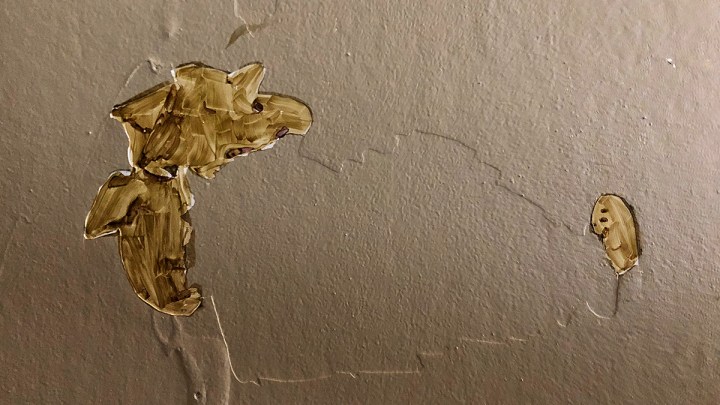
I removed one recently and some of the paint stuck to the back of the tape holding it up. I tried to peel it off in the hope I could glue it back in place, but it crumbled into multiple bits. Insert swear words. I like to swear but I am really trying not to anymore. That’ another post. I was struck with the fact that I could either prioritize making art or prioritize living in a nice-looking home. Of course, I should have saved some of the paint for touch ups. But damn, how many things is one supposed to get right?! Whoops! A little swear blurped out.

It gets worse. I figured if I didn’t have any paint, I would just use one of my colored markers to touch it up. You can see the hideous results for yourself. What an ugly mess. I don’t know what we are going to do. I am so annoyed and yet I don’t know how it could be different. I want to prioritize art. Period! But I also don’t want to live in dilapidation. Oh well. Can’t have it all. But I can put a little eye and mouth on the hideous smear and at least amuse myself. Laughing to keep from crying.